


Road accidents remain an unavoidable part of Canberra’s transport network.
Although the ACT consistently records one of Australia’s lowest road fatality rates, thousands of crashes still occur each year, ranging from minor property-damage collisions to serious incidents involving injuries and fatalities.
These statistics provide valuable insight into how often crashes occur, who is most at risk and how road safety is changing across Canberra.
They also help distinguish between reported crashes, casualty crashes, road deaths, serious injuries and motor accident insurance claims, which are often incorrectly used interchangeably.
Throughout this article, we clearly separate these measures to provide an accurate picture of road safety in the ACT. The latest complete official crash statistics currently cover 2025, with more recent road toll and insurance data referenced separately where appropriate.
Key Canberra Road Accident Statistics (2026)
The latest official data provides a snapshot of road safety across Canberra and the ACT.
- 11 road fatalities were recorded in the ACT in 2024.
- 11 fatal crashes, 539 injury crashes and 5,024 property-damage crashes occurred during 2024.
- 595 people received medical treatment following road crashes, including 74 hospital admissions.
- Five of the 11 road fatalities in 2024 were motorcycle riders.
- The ACT recorded a fatality rate of 2.32 deaths per 100,000 people, compared with the Australian average of 4.78 per 100,000.
- As of 31 March 2026, the ACT Motor Accident Injuries Scheme had received 2,458 complete injury applications since February 2020, including 97 during the March 2026 quarter.
These figures show that road crashes create consequences well beyond the official fatality count, including injuries, damaged vehicles, traffic disruption and the need for professional accident towing services in Canberra.
If your vehicle can’t be driven after a collision, it’s also worth understanding how much a tow truck costs in Canberra before arranging recovery.
Canberra's Road Safety Landscape
Canberra consistently ranks among Australia’s safest jurisdictions for road users, yet maintaining that position requires continuous investment in infrastructure, enforcement, education and post-crash care.
The ACT Government’s Road Safety Framework 2026–2031 adopts the internationally recognised Safe System approach, which accepts that while human error cannot be eliminated entirely, roads and vehicles should be designed to reduce the likelihood that mistakes result in death or serious injury.
The framework focuses on five connected priorities: safer people, safer roads, safer speeds, safer vehicles and improved post-crash response.
This approach aligns with Australia’s broader National Road Safety Strategy, which seeks to reduce fatalities and serious injuries through coordinated improvements across infrastructure, enforcement, vehicle safety and driver behaviour rather than relying on any single solution.
Road safety also extends beyond preventing collisions. Once a crash occurs, rapid emergency response, effective traffic management and timely vehicle recovery all play a role in reducing secondary crashes and minimising disruption across the transport network.
From Underground Towing & Salvage’s perspective, this is often the stage of the incident that motorists overlook.
Clearing damaged vehicles safely and efficiently helps emergency services complete their work, reduces congestion for other road users and lowers the risk of additional collisions forming around an accident scene.
This practical aspect of road safety receives far less attention than crash prevention, yet it remains an essential part of keeping Canberra’s roads moving.
How Many Road Accidents Occur in Canberra Each Year?
Road fatalities receive the greatest public attention, but they represent only a small proportion of crashes recorded across the ACT.
Most incidents involve property damage or non-fatal injuries, highlighting the broader impact road accidents have on motorists, insurers, emergency services and traffic movement.
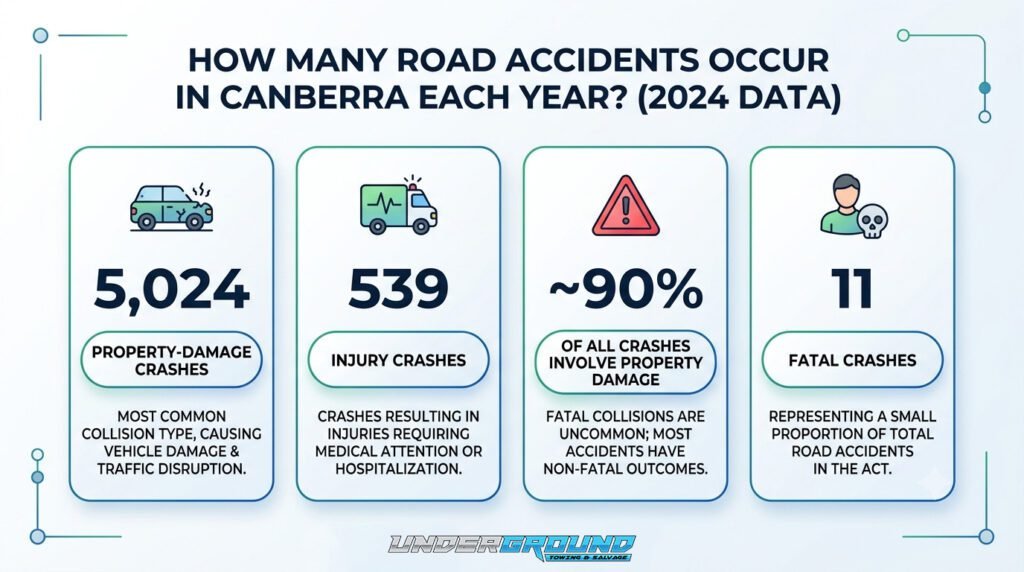
According to the ACT Road Safety Report Card 2025, there were 11 fatal crashes, 539 injury crashes and 5,024 property-damage crashes recorded across the ACT during 2024. Property-damage crashes accounted for around 90% of all reported crashes, showing that while fatal collisions are relatively uncommon, vehicle damage and traffic disruption remain everyday realities on Canberra’s road network.
Looking at the past five years shows that overall crash volumes have remained relatively stable, despite fluctuations in fatal crashes.
Year | Fatal Crashes | Injury Crashes | Property-Damage Crashes |
2020 | 6 | 534 | 5,220 |
2021 | 11 | 514 | 5,319 |
2022 | 15 | 490 | 5,077 |
2023 | 4 | 554 | 5,340 |
2024 | 11 | 539 | 5,024 |
Although the number of fatal crashes varies from year to year, injury and property-damage crashes have consistently remained within a relatively narrow range.
This suggests that while the severity of crashes changes over time, collisions continue to occur regularly across Canberra’s road network.
Wildlife collisions add another dimension to Canberra’s road safety picture. ACT Parks and Conservation Service attended more than 4,450 animal-vehicle collision callouts across Canberra in 2024–25, showing how frequently wildlife and vehicles come into conflict across the region. Kangaroos are a particular concern for local motorists, especially around roads bordering grassland, bushland and nature reserves. If you’re involved in one of these collisions, our guide explains what to do after hitting a kangaroo in Canberra, including how to report the animal and determine whether your vehicle is safe to drive.
The ACT Government also maintains a comprehensive Road Crash Data database containing reported crashes by location, suburb, road, severity and other characteristics. This dataset is particularly valuable for identifying crash hotspots and analysing long-term trends across Canberra.
It is important to note that it includes crashes reported through recognised ACT Policing reporting channels and may not capture every minor collision.
For many motorists, these statistics reinforce an important point: most crashes are not fatal, but many still leave vehicles unsafe to drive.
Damage to steering, suspension, wheels, airbags or structural components may not always be immediately obvious, making professional Towing Canberra services the safest option following a collision, even when injuries are minor.
Canberra Road Fatalities and Long-Term Trends
Although the ACT records relatively few road deaths compared with larger states, even small changes can produce noticeable year-to-year fluctuations. Looking beyond individual years provides a more accurate understanding of long-term road safety performance.
The ACT recorded 11 road fatalities in 2024, following four in 2023, 18 in 2022, 11 in 2021 and seven in 2020. The sharp increase between 2023 and 2024 should not be viewed in isolation.
Because Canberra has a relatively small population, a handful of additional fatal crashes can significantly alter annual totals without necessarily indicating a long-term deterioration in road safety.
Despite the increase in 2024, the ACT continues to record one of the lowest road fatality rates in Australia.
The territory reported 2.32 deaths per 100,000 people, compared with the national average of 4.78 deaths per 100,000 people. This reflects the combined impact of safer road infrastructure, lower average travel distances, modern vehicle safety technologies and ongoing investment in road safety initiatives.
The official ACT Road Toll maintained by ACT Policing tracks road deaths over several decades and follows nationally consistent definitions. A road death includes any person who dies within 30 days of injuries sustained in a road crash but excludes deliberate acts, natural causes and incidents occurring on private property. Using a consistent definition allows meaningful comparisons between jurisdictions and over time.
Nationally, the trend has been less encouraging. Australian Government data shows 1,350 people were killed on Australian roads in the 12 months to 30 September 2025, representing a 6.8% increase on the equivalent previous period.
While the ACT continues to outperform the national average, it remains influenced by the same broad challenges affecting road safety across Australia, including speeding, vulnerable road users and increasingly complex traffic environments.
For readers comparing Canberra with the rest of Australia, the Australian Road Deaths Database and BITRE Road Safety Statistics provide nationally consistent fatal crash data by jurisdiction, age, gender and road-user type.
These datasets are particularly useful for understanding how the ACT’s comparatively small road toll fits within broader Australian trends.
Serious Injuries, Casualty Crashes and Hospitalisations
Road fatalities represent only the most severe outcome of a collision. Every year, many more people suffer injuries that require emergency treatment, hospital care or ongoing rehabilitation.
During 2024, the ACT recorded 539 injury crashes, resulting in 595 people receiving medical treatment and 74 hospital admissions. These figures demonstrate that a single crash can injure multiple people and that the number of casualties is not the same as the number of crashes.
Understanding this distinction is important when interpreting road safety data:
- A reported crash refers to an individual collision.
- An injury crash is a crash where at least one person is injured.
- A casualty is an individual person injured or killed.
- A hospital admission measures those whose injuries required inpatient treatment.
Each metric measures a different aspect of road trauma and should not be compared interchangeably.
The broader health impact extends well beyond the ACT. The Australian Institute of Health and Welfare continues to report thousands of transport-related hospitalisations each year, particularly among vehicle occupants, motorcyclists, cyclists and pedestrians.
Hospital data complements police crash reports by capturing the ongoing healthcare burden associated with road accidents rather than simply the collision itself.
From a recovery perspective, injury crashes also tend to require more complex scene management.
Police investigations, ambulance treatment, vehicle stabilisation and debris removal can significantly increase the time needed to safely reopen affected roads, particularly on major arterial routes.
Which Road Users Are Most at Risk?
Not every road user faces the same level of risk. The latest ACT statistics show that certain groups remain disproportionately represented in fatal and serious crashes despite making up a relatively small proportion of overall road users.
The most striking finding from 2024 was the number of motorcycle fatalities.
Five of the ACT’s 11 road deaths involved motorcyclists, meaning riders accounted for almost half of all fatalities recorded during the year. Considering motorcycles represent only a small share of registered vehicles, this highlights the significantly greater injury risk faced by riders during collisions.
This pattern is also reflected nationally, with motorcycle riders continuing to be over-represented in road fatalities despite accounting for only a small proportion of registered vehicles. Improving motorcycle safety remains a key focus of Australia’s National Road Safety Strategy.
Cyclists and pedestrians also require particular attention because they lack the physical protection available to vehicle occupants.
The ACT Government maintains dedicated crash datasets for both groups, allowing researchers and planners to identify recurring collision locations, infrastructure issues and broader safety trends throughout Canberra.
Unlike police crash reports, recent ACT motorcycle research has also examined rider-reported incidents and near misses.
The Motorcyclist Incident Reporting Tool found that many hazardous situations never result in police attendance yet still provide valuable insight into road conditions, driver behaviour and infrastructure that may contribute to future crashes.
These findings help identify emerging risks before they appear in official crash statistics.
For towing operators, vulnerable road user crashes often require additional care during recovery operations.
Motorcycles, bicycles and personal mobility devices frequently sustain damage that is less obvious than a conventional passenger vehicle, making specialised transport methods essential to prevent further damage after the collision.
Who Is Most Commonly Involved in Canberra Road Crashes?
Age remains one of the strongest demographic indicators within ACT crash statistics.
The 2023 ACT Crash Report found that drivers aged 15–29 accounted for 34.9% of vehicle-controller casualties despite representing only 22.4% of ACT licence holders. This over-representation suggests younger drivers continue to experience a higher risk of involvement in casualty crashes than their overall share of licensed motorists would indicate.
The report also examines crash involvement across other age groups, gender and licence-holder demographics, helping policymakers identify where education, enforcement and infrastructure improvements may have the greatest impact.
These demographic trends should be interpreted carefully. They do not mean that age alone causes crashes.
Factors such as driving experience, travel frequency, exposure, vehicle type and driving conditions all influence collision risk. Demographic analysis is most valuable when combined with broader crash data rather than viewed in isolation.
About Underground Towing & Salvage
Road accident statistics highlight more than fatalities and injuries. Every year, thousands of collisions across Canberra leave vehicles damaged, block traffic lanes and require safe recovery before roads can fully reopen.
At Underground Towing & Salvage, we provide 24/7 accident towing and vehicle recovery throughout Canberra, assisting motorists, emergency services and insurers when vehicles cannot be safely driven.
Our experienced team is equipped to recover vehicles from roadside incidents, multi-vehicle collisions, underground car parks and other challenging locations, with a focus on safety, clear communication and prompt response times.
If you’ve been involved in an accident and your vehicle is no longer roadworthy, our team is available around the clock to provide fast, professional towing assistance.