
Kangaroo collisions are a significant road-safety issue in Canberra. They occur across suburban roads, major arterial routes and roads bordering grassland and wildlife habitat, but the risk is not evenly distributed across the ACT.
ACT Government estimates suggest that between 2,600 and 5,800 kangaroos are killed or seriously injured on Canberra roads each year, depending on the method used to estimate incidents.
The problem is familiar to many Canberra motorists. Around 36% of Canberra residents surveyed reported having been in a vehicle that struck a kangaroo in the ACT at some point.
But the risk is not simply a matter of how many kangaroos live around Canberra. Location, road speed, surrounding habitat, time of day, season and weather conditions all influence the likelihood of a collision.
So, where are Canberra drivers most at risk, and when should they be most alert?
How Common Are Kangaroo Collisions in Canberra?
There is no single database recording every kangaroo collision in the ACT. Some incidents are reported to authorities, some result in insurance claims, and others may never be formally recorded.
That makes the distinction between datasets important.
ACT Parks data indicates that an average of around 2,600 kangaroos per year required ranger attendance following road incidents. This is a useful measure of recorded incidents, but it does not capture every kangaroo struck by a vehicle.
The ACT Government’s broader independent review estimates that approximately 2,600–5,800 kangaroos are killed or seriously injured on Canberra roads annually. The range reflects the difference between ranger records and estimates derived from resident survey data.
This means the lower figure should not be read as a complete count of every collision, while the upper figure should not be presented as a police-recorded total. They measure the problem differently.
There is also detailed spatial evidence available. An Australian National University-led study examined 3,346 ranger-recorded kangaroo-vehicle collision locations across Canberra between March 2016 and June 2017.
That dataset is particularly valuable because it shows that kangaroo collisions are not randomly distributed across Canberra. Certain roads and road environments experience substantially greater exposure.
Where Are Canberra Drivers Most at Risk of Hitting a Kangaroo?
The strongest answer comes directly from the ACT Government’s current kangaroo-collision hotspot information.
Four roads are classified as “exceptional hotspots”:
- Fairbairn Avenue
- Majura Road
- Hindmarsh Drive
- Mugga Lane
These locations deserve particular attention because the designation comes from ACT Government collision evidence rather than anecdotal reports or general wildlife sightings.
The Government identifies another 12 roads as kangaroo-collision hotspots:
Limestone Avenue, Sulwood Drive, William Hovell Drive, Antill Street, Woodcock Drive, Monaro Highway, Long Gully Road, Yamba Drive, Athllon Drive, Tuggeranong Parkway, Tharwa Drive and Erindale Drive.
Together, these roads give Canberra motorists a much clearer picture of geographic risk.
They also show that kangaroo collisions are not confined to remote rural roads. The official list includes major arterial routes and roads passing through or beside developed parts of Canberra.
William Hovell Drive Stands Out Across Different Datasets
William Hovell Drive is particularly noteworthy because it appears in two independent forms of evidence.
The ACT Government classifies the road as a kangaroo-collision hotspot.
Separately, NRMA’s 2025 insurance data identified William Hovell Drive as the ACT road with the highest number of animal-collision claims.
The distinction matters. NRMA’s figure covers animal collisions and is not a kangaroo-only collision count. It should not be used to calculate how many kangaroos are struck on William Hovell Drive.
What it does provide is independent evidence that wildlife collisions on the road are generating insurance claims, while the ACT Government’s separate dataset specifically identifies it as a kangaroo hotspot.
Broader insurer data adds some geographic context. Suncorp/AAMI identified Canberra, Hume, Belconnen, Kambah and Majura as leading ACT locations for animal-collision claims.
Again, these are animal-collision insurance locations, not confirmed kangaroo hotspots. They are useful as supporting indicators, but the ACT Government hotspot classifications remain the stronger evidence when identifying roads where kangaroo collisions are known to occur frequently.
When Are Canberra Drivers Most at Risk?
Location is only half of the picture. Kangaroo collision risk also changes substantially throughout the day.
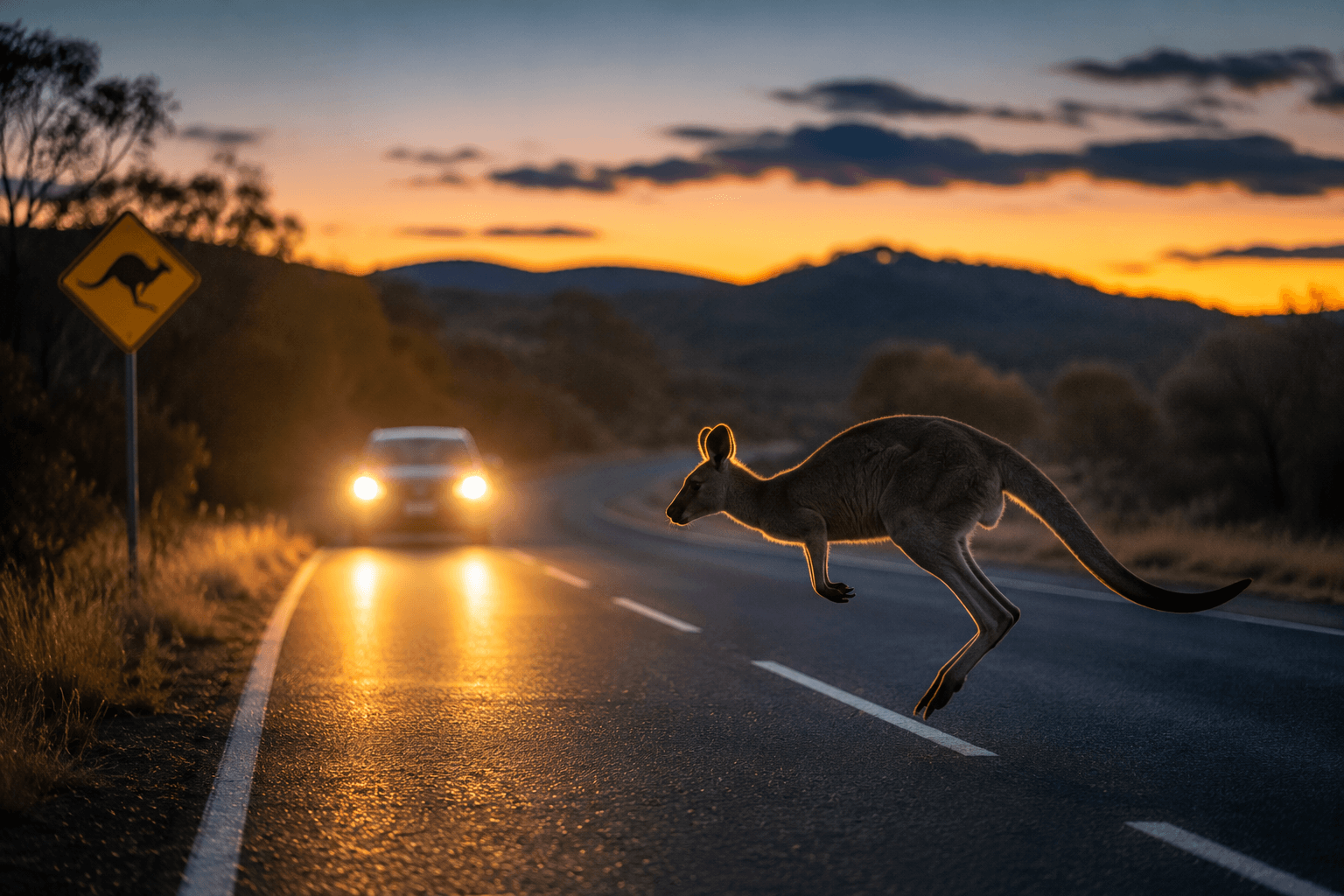
The ACT Government identifies 5 pm to 10 pm as the main peak period for kangaroo collisions, with increased risk also associated with early morning, dusk and night-time driving.
That timing makes practical sense for drivers. Kangaroos are more active during lower-light periods, while reduced visibility gives motorists less time to identify an animal approaching or entering the roadway.
Transport Canberra and City Services similarly advises motorists to be particularly alert during early morning, dusk and night, when wildlife is more likely to cross roads.
For Canberra motorists, the important takeaway is not that risk suddenly begins at 5 pm and disappears at 10 pm. Rather, the strongest ACT evidence shows that evening and other low-light periods deserve additional caution, particularly on roads already identified as collision hotspots.
Insurance data provides another perspective. Suncorp/AAMI’s ACT animal-collision claims recorded 12 am to 6 am as the leading time period for claims.
This does not contradict the ACT Government’s 5 pm–10 pm kangaroo finding. The datasets measure different things: one relates specifically to kangaroo collision risk, while the insurer data covers broader animal-related claims.
Taken together, they point towards the same practical pattern: wildlife collision exposure is elevated after daylight fades and through the night.
Which Months and Seasons Carry the Greatest Risk?
Seasonal patterns are more complicated than simply identifying one “worst month”.
ACT Government analysis indicates that kangaroo collisions tend to increase during winter and periods of dry weather, when changing food availability can cause kangaroos to travel further.
The Canberra-specific ANU study reached a similar finding. Its analysis of 3,346 ranger-recorded collision locations found that winter recorded the highest roadkill numbers, although the researchers cautioned that season alone could not explain the overall collision pattern.
That qualification is important. A Canberra driver should not assume that kangaroo risk becomes low simply because winter has ended.
The ACT’s 2023 experience demonstrates why.
Suncorp/AAMI’s separate insurance data also recorded October as the highest month for animal-collision claims in the ACT.
These datasets should not be combined to claim that October is always Canberra’s worst month for kangaroo collisions. One measures ranger-attended kangaroo incidents during a particular period; the other measures broader animal-related insurance claims.
The stronger conclusion is that winter is an established seasonal risk period, but dry conditions can extend or shift heightened collision risk into other parts of the year.
Why Dry Conditions Can Push Kangaroos Closer to Canberra Roads
Weather affects collision risk because it affects where kangaroos move and feed.
During prolonged dry conditions, food availability can decline across normal grazing areas. Kangaroos may travel further to find suitable feed, increasing the likelihood that their movements intersect with roads. ACT Government analysis identifies dry conditions as one of the factors associated with increased kangaroo-vehicle collisions.
Roadsides can also become attractive feeding areas.
Transport Canberra and City Services notes that water running off roads can encourage greener grass beside the roadway, attracting kangaroos and wallabies towards traffic corridors.
This helps explain why collision risk cannot be understood simply by looking at kangaroo population numbers.
For drivers, what matters is where animals are moving and feeding relative to the road. A high-speed route running beside grassland or kangaroo habitat can create a very different risk environment from a lower-speed urban street, particularly after dark or when dry conditions encourage animals to seek food elsewhere.
What Makes Some Canberra Roads More Dangerous Than Others?
The official hotspot list shows that kangaroo collision risk is concentrated on particular roads, but the road name itself is only part of the explanation.
ACT Government analysis associates higher collision risk with roads carrying speed limits of 80 km/h or above and roads adjoining areas with high kangaroo densities.
Speed matters because the consequences of an unexpected crossing become harder to avoid as vehicle speed increases. Drivers have less time to recognise the hazard, brake and reduce the severity of an impact.
The surrounding environment matters as well.
ACT research has identified short roadside grass, intersections and the ends of wildlife barrier fencing among the factors associated with kangaroo collision risk.
These factors help explain why risk can vary even along the same road. A particular section where habitat, feeding areas or established animal movements meet fast-moving traffic may present a greater problem than another section several kilometres away.
For Canberra motorists, the combination that deserves particular attention is straightforward: higher speeds, nearby kangaroo habitat, attractive roadside vegetation and reduced visibility.
Add dusk, night-time or dry conditions to that combination and the margin for reacting to an animal entering the road becomes smaller again.
What Are the Consequences of a Kangaroo Collision?
The large number of kangaroo strikes in Canberra does not mean every collision results in an injured driver. The consequences can range from relatively minor vehicle damage to an undriveable car or a serious secondary crash.
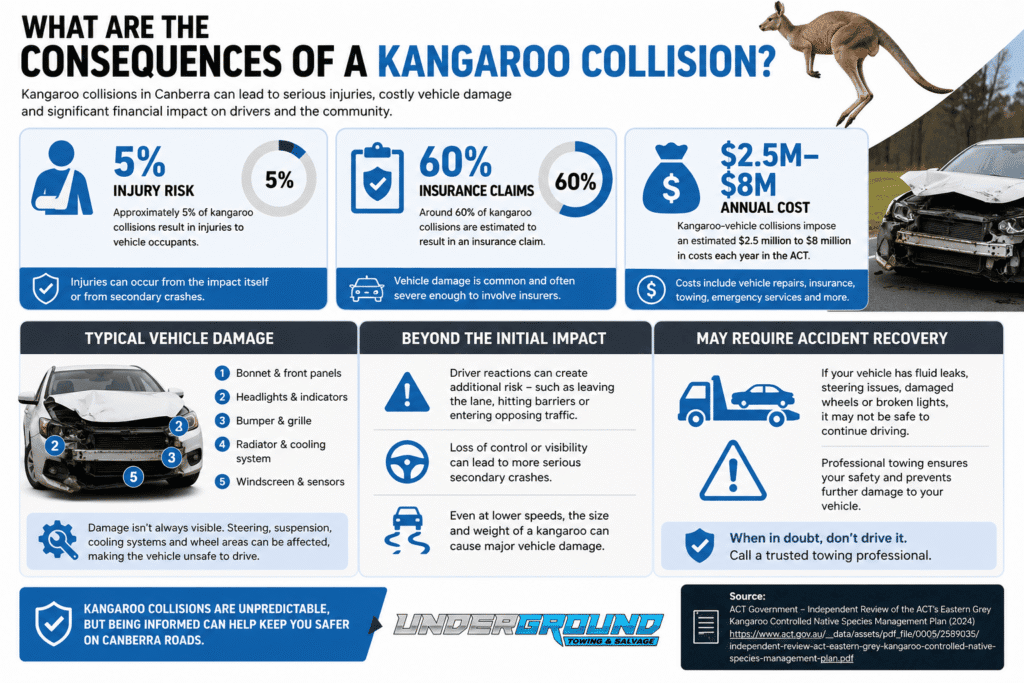
ACT evidence reviewed by the Government estimates that approximately 5% of kangaroo collisions result in injuries to vehicle occupants.
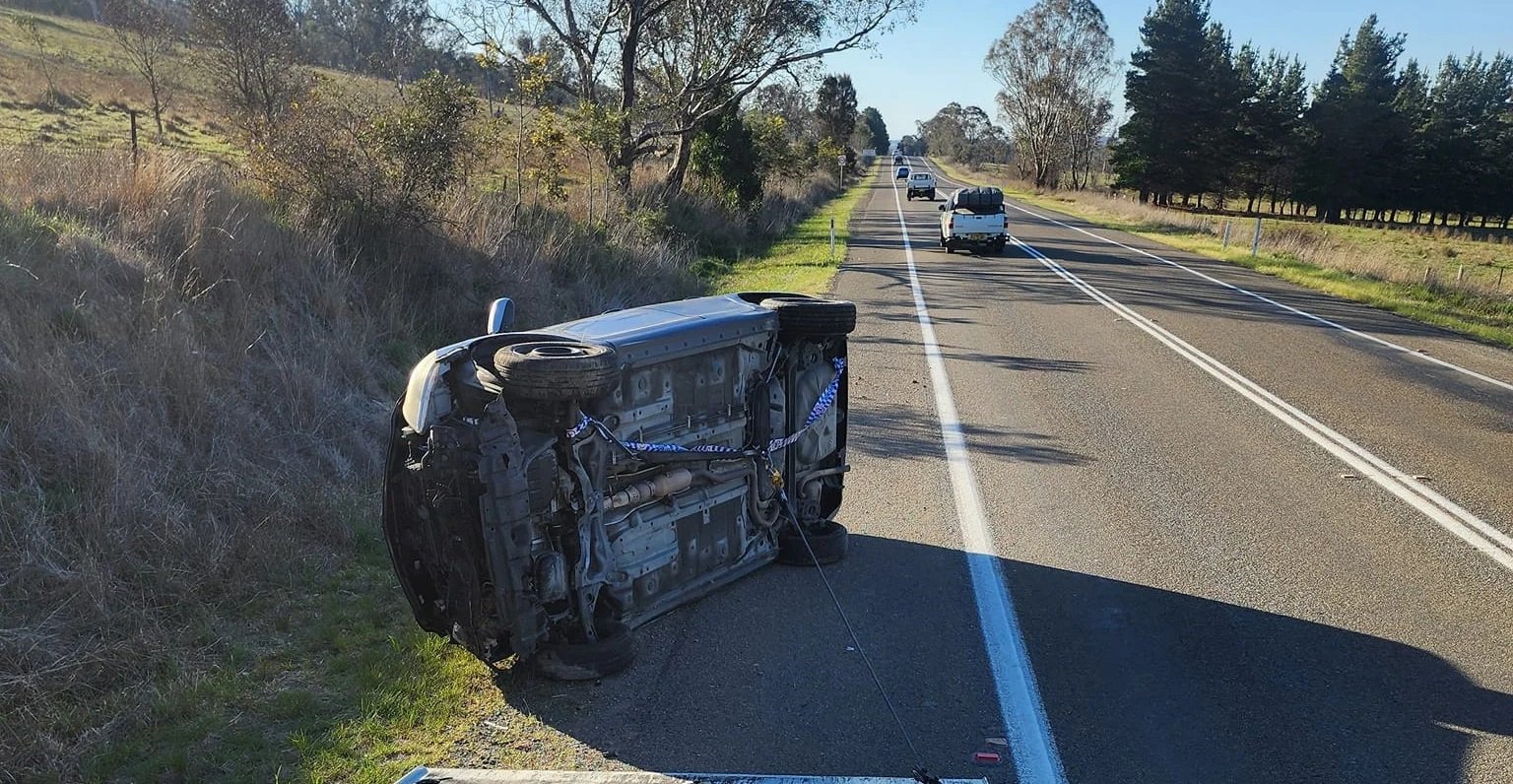
That figure also highlights an important road-safety issue: the danger is not limited to the initial impact with the animal. A driver’s reaction can create additional risk, particularly if the vehicle leaves its lane, enters opposing traffic or departs the roadway.
Vehicle damage is considerably more common.
Approximately 60% of kangaroo collisions were estimated to result in an insurance claim, indicating that a substantial proportion cause damage significant enough for motorists to involve their insurer.
The same ACT review estimates that kangaroo-vehicle collisions impose an economic cost of approximately $2.5 million to $8 million each year in the ACT.
For the individual motorist, the immediate concern is whether the vehicle remains safe to drive.
A kangaroo strike can affect the front bumper, headlights, bonnet, windscreen and components behind the front of the vehicle. Damage to the radiator, cooling system, steering, suspension or wheel area can make continuing the journey unsafe even when the vehicle still starts and moves.
From an accident recovery perspective, visible body damage is not always a reliable measure of whether a vehicle should remain on the road. Fluid loss, damaged steering components, tyre contact or broken lighting can turn what initially appears to be a manageable impact into a roadside recovery.
What Insurance Claims Tell Us About Wildlife Collisions
Insurance data provides another way to measure the practical impact of wildlife strikes, although it needs to be interpreted separately from confirmed kangaroo collision records.
NRMA analysed more than 15,000 animal-collision claims during 2025 and found kangaroos accounted for approximately 84% of wildlife-related claims nationally.
That is a national statistic rather than a Canberra-specific kangaroo collision rate. Its value is in showing just how dominant kangaroos are within Australian wildlife-related motor claims.
The ACT-specific insurance evidence is useful in a different way.
As noted earlier, NRMA identified William Hovell Drive as the ACT road with the highest number of animal-collision claims in its 2025 data.
Suncorp/AAMI separately identified Canberra, Hume, Belconnen, Kambah and Majura as leading ACT locations for animal-collision claims, while its timing data showed October and the midnight-to-6 am period featuring prominently.
These figures should not be converted into kangaroo collision totals. Insurer datasets can include strikes involving other animals, and different insurers have different customer bases.
What they do provide is another indicator of where and when wildlife collisions are resulting in real vehicle damage and insurance claims.
When insurance evidence overlaps with official kangaroo data, as it does with William Hovell Drive, the case for motorists exercising additional caution becomes stronger.
How Canberra Drivers Can Reduce Their Kangaroo Collision Risk
No driver can completely remove the possibility of encountering a kangaroo. The available evidence does, however, identify situations where extra caution is warranted.
The highest-priority conditions are:
- driving on an officially identified kangaroo collision hotspot;
- travelling around 5 pm to 10 pm, at dawn or after dark;
- driving during winter or prolonged dry conditions;
- travelling at higher speeds through areas adjoining grassland or kangaroo habitat; and
- approaching sections where roadside vegetation, intersections or fencing may influence animal movement.
The ACT Government identifies 5 pm to 10 pm as the main peak period for kangaroo collisions, while its guidance also highlights early morning, dusk and night as periods when motorists should be particularly alert.
Reducing speed when conditions warrant it gives a driver more time to recognise an animal and brake.
If a collision becomes unavoidable, Transport Canberra and City Services advises motorists to brake rather than swerve, because suddenly changing direction can lead to a more serious crash.
After an impact, personal safety comes first. Move away from moving traffic where it is safe to do so, assess whether anyone is injured and do not approach an injured kangaroo unnecessarily.
The vehicle also needs to be assessed before continuing.
A damaged bumper alone may not prevent a car from moving, but leaking coolant, damaged lights, steering problems, tyre interference or loose bodywork can make it unsafe to drive. When there is doubt, arranging professional towing company Canberra is safer than attempting to drive a damaged vehicle from the scene.
Kangaroos, Canberra's Landscape and the Road Network
Canberra’s kangaroo collision problem is closely connected to the way the city’s road network intersects with open space.
Kangaroos move through grassland, reserves and other suitable habitat, while many Canberra arterial roads pass directly beside these environments. Collision risk emerges where animal movement and vehicle movement repeatedly cross.
The ACT Government’s research shows that kangaroo density, higher road speeds, short grass, intersections and particular fencing configurations can all influence collision risk.
That makes the problem more complex than simply reducing the number of kangaroos.
The evidence instead points towards a combination of wildlife management, road design, fencing, vegetation management, driver awareness and appropriate speeds in higher-risk environments.
For motorists, this also explains why kangaroos can appear unexpectedly on roads that do not feel particularly remote. A road can be part of Canberra’s normal urban transport network while still running beside habitat capable of supporting regular kangaroo movement.
Where and When Is the Risk Highest? The Evidence in Brief
The available ACT evidence gives Canberra motorists a reasonably clear answer to the two questions at the centre of this analysis.
Where?
The ACT Government classifies Fairbairn Avenue, Majura Road, Hindmarsh Drive and Mugga Lane as exceptional kangaroo collision hotspots.
A further group of recognised hotspots includes Limestone Avenue, Sulwood Drive, William Hovell Drive, Antill Street, Woodcock Drive, Monaro Highway, Long Gully Road, Yamba Drive, Athllon Drive, Tuggeranong Parkway, Tharwa Drive and Erindale Drive.
When?
The strongest ACT-specific evidence identifies 5 pm to 10 pm as the main peak collision period, with heightened risk also associated with dawn, dusk and night-time driving.
Seasonally, winter is the clearest recurring higher-risk period, but dry conditions can increase kangaroo movement and shift collision peaks later in the year.
The 2023 ranger data illustrates this variation: incidents increased through winter and spring before peaking in October during hot, dry conditions.
For Canberra drivers, the highest-risk scenario is therefore not defined by one road or one month. Risk builds when several factors overlap: a known hotspot, higher vehicle speed, nearby kangaroo habitat, low light and environmental conditions that encourage greater animal movement.
What These Statistics Mean for Canberra Motorists
Canberra’s kangaroo collision problem is substantial. Thousands of kangaroos are estimated to be killed or seriously injured on the city’s roads each year, and more than one-third of surveyed residents have experienced being in a vehicle that struck one.
More importantly for drivers, the risk is not completely unpredictable.
The ACT has identified specific hotspot roads. Research has established meaningful time-of-day and seasonal patterns. Road speed, habitat, vegetation and dry weather all help explain why some journeys carry greater risk than others.
Knowing those patterns gives motorists an opportunity to adjust.
Slow down when travelling through recognised hotspots after dark. Pay closer attention to the road verge as well as the lane ahead. Treat prolonged dry periods as an additional warning sign rather than assuming kangaroo risk is confined to winter.
And if a collision does occur, do not assume that a vehicle is safe simply because it remains driveable.
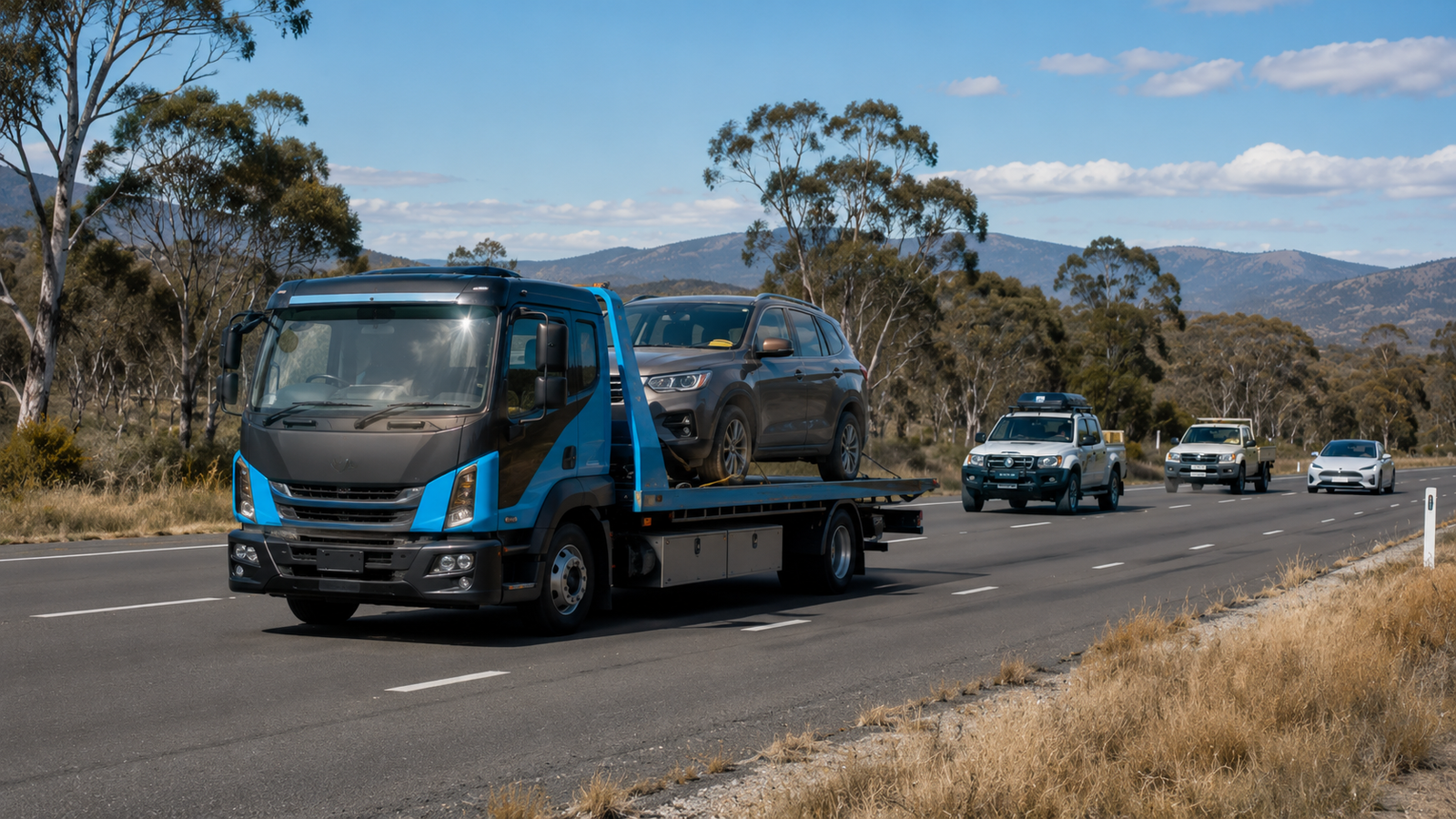
Underground Towing & Salvage regularly deals with vehicles that cannot safely continue after accidents and roadside incidents across Canberra. Where a kangaroo strike has caused significant damage, the priority is to get the occupants out of danger and recover the vehicle without creating another road-safety risk.
If towing is required, motorists can review Underground Towing & Salvage’s Canberra towing service. Drivers comparing operators after an accident can also use this guide on how to choose a reputable tow truck in Canberra to understand what to look for before arranging recovery.
Kangaroos are part of Canberra’s landscape, and encounters on the road cannot always be avoided. The statistics do show something useful, though: knowing where the established hotspots are and when collision risk increases gives drivers a better chance to recognise the danger before an animal reaches the road.