

Road crashes remain a significant road safety issue across Tasmania, affecting motorists, businesses and emergency services every year.
While the annual road toll receives the most attention, fatalities represent only one measure of road trauma.
This article examines the latest official Tasmania road accident statistics, including fatalities, serious injuries, crash trends, contributing factors and regional road safety patterns.
Using data from Transport Services Tasmania, Tasmania Police, BITRE, MAIB and other government sources, it provides a comprehensive overview of road safety across the state and what the latest figures reveal.
Tasmania Road Safety at a Glance
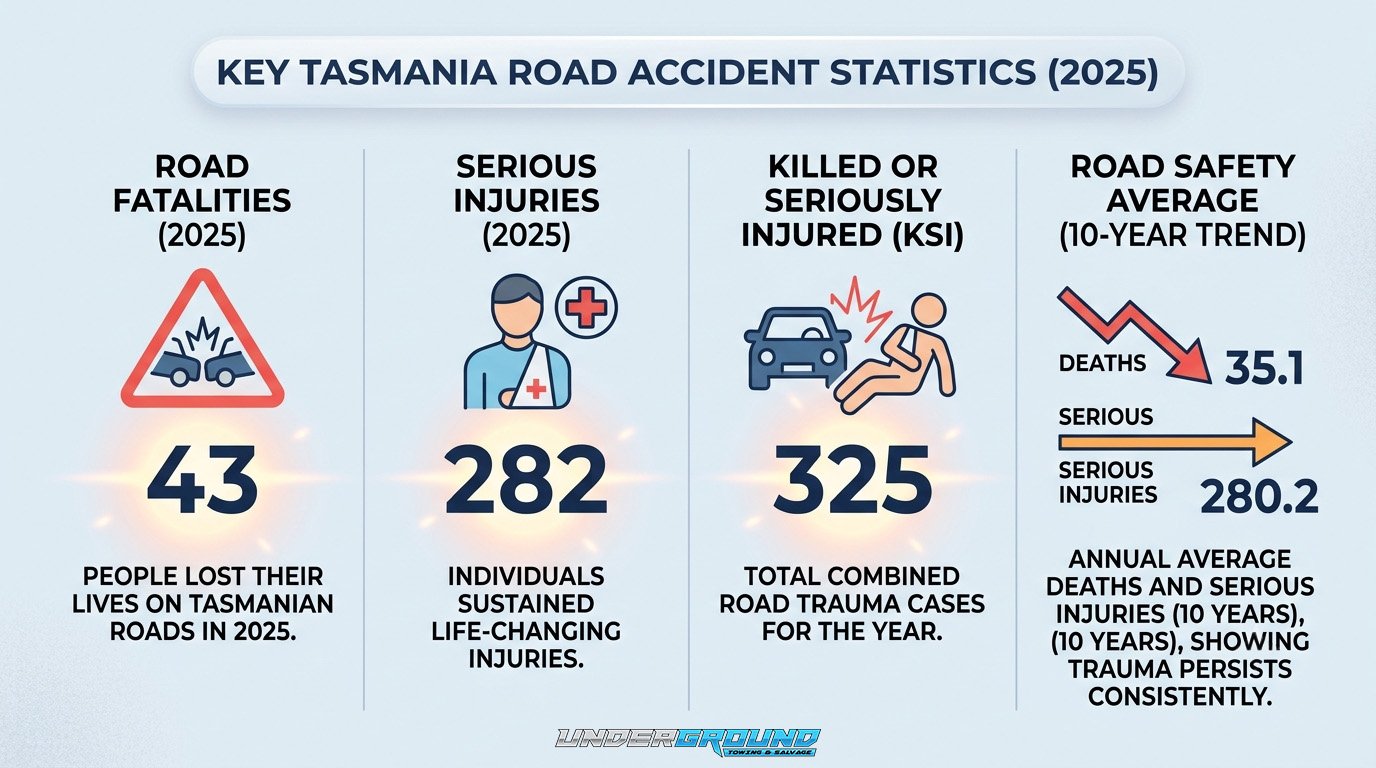
The latest completed data shows that 43 people lost their lives on Tasmanian roads during 2025, while 282 people sustained serious injuries.
Combined, 325 people were either killed or seriously injured, highlighting that road trauma remains a significant issue despite ongoing investment in road safety initiatives.
Although the number of fatalities receives the greatest attention, serious injuries have an equally significant impact.
Survivors often face lengthy rehabilitation, ongoing medical treatment and substantial financial costs, while crashes also place pressure on emergency services, hospitals, insurers and vehicle recovery operators across Tasmania.
The scale of Tasmania’s transport network helps explain why road safety remains such an important issue. As at 31 December 2025, the state had 446,076 licensed drivers and 735,165 registered vehicles and vehicle units, including passenger vehicles, motorcycles, commercial vehicles, trucks and trailers.
With hundreds of thousands of vehicles travelling across urban streets, regional highways and remote rural roads every day, even relatively small changes in crash rates can affect a large number of road users.
What Affects the Cost of a Tow Truck?
No two towing jobs are exactly the same, which is why there isn’t a single fixed price. The final cost depends on the type of recovery, the vehicle involved and the work required to complete the job safely.
The main factors that affect towing costs include:
- Distance: Where the vehicle is located and where it needs to be transported.
- Vehicle type: Larger vehicles, motorcycles, caravans, machinery and non-running vehicles may require different equipment or handling.
- Accessibility: Recoveries from underground car parks, apartment basements, narrow driveways or restricted-access areas are often more complex than a standard roadside tow.
- Recovery complexity: Accident-damaged vehicles, off-road recoveries, locked wheels or vehicles requiring winching generally take more time and specialist equipment.
- Time of service: After-hours, overnight, weekend or public holiday call-outs may affect the final price depending on the circumstances.
The more information you can provide when requesting a quote, the easier it is for a towing company to recommend the right truck and provide accurate upfront pricing.
Key Tasmania Road Accident Statistics
- 43 road fatalities were recorded during 2025.
- 282 people were seriously injured in road crashes during 2025.
- 325 people were killed or seriously injured during the year.
- Tasmania’s 10-year average sits at 35.1 road deaths and 280.2 serious injuries annually, showing that serious trauma has remained consistently high over the past decade.
- The state had 735,165 registered vehicles and 446,076 licensed drivers at the end of 2025.
These figures provide an important benchmark for understanding the sections that follow.
Looking only at one year’s road toll can be misleading, so it is equally important to examine how fatalities and serious injuries have changed over time.
Tasmania Road Fatality Trends
Road fatalities in Tasmania rarely follow a consistent pattern. Individual years can vary significantly depending on a relatively small number of serious crashes, which is why long-term trends provide a much more reliable measure of road safety performance.
The latest official figures illustrate this clearly.
Year | Road Fatalities |
2021 | 35 |
2022 | 50 |
2023 | 35 |
2024 | 31 |
2025 | 43 |
Source: https://www.transport.tas.gov.au/road_safety_and_rules/crash_statistics
The increase to 50 fatalities during 2022 represented Tasmania’s highest road toll in several years before falling to 35 deaths in 2023 and 31 in 2024.
While that decline appeared encouraging, the road toll increased again to 43 fatalities during 2025, demonstrating how quickly annual results can change.
This volatility is common in smaller jurisdictions like Tasmania.
Unlike larger states where thousands of casualty crashes occur each year, a relatively small number of additional fatal crashes can produce a noticeable increase in annual totals.
That makes it important to assess trends across multiple years rather than drawing conclusions from a single reporting period.
The state’s 10-year average of 35.1 fatalities reinforces this point. Although some years perform better than average, others significantly exceed it, indicating that Tasmania continues to experience periods of elevated road trauma.
Looking beyond Tasmania also provides useful context. BITRE’s Australian Road Deaths Database allows road fatalities to be compared nationally by jurisdiction, road user type, age and crash characteristics.
This broader perspective helps determine whether Tasmania’s trends reflect wider national patterns or unique state-specific issues.
As 2026 progresses, BITRE’s monthly Road Deaths Australia bulletins provide preliminary year-to-date updates.
These figures are useful for monitoring emerging trends but should always be treated as preliminary until final annual statistics are released by the Tasmanian Government.
Serious Injuries Continue to Exceed Road Safety Targets
Fatalities represent only one part of Tasmania’s road trauma.
For every person killed, many more survive with life-changing injuries that require extensive medical treatment and rehabilitation.
From both a public health and transport perspective, serious injuries are one of the most important measures of road safety performance.
Recent figures show:
Year | Serious Injuries |
2023 | 310 |
2024 | 308 |
2025 | 282 |
Source: https://www.transport.tas.gov.au/road_safety_and_rules/crash_statistics
While the reduction from 310 serious injuries in 2023 to 282 in 2025 represents progress, the numbers remain close to Tasmania’s 10-year average of 280.2 serious injuries per year, indicating that serious crashes continue to occur at a consistently high level.
It is also important to understand the terminology used within official crash reports.
- Road fatalities count people who lose their lives following a road crash.
- Serious injuries count people who sustain significant injuries as defined by the state’s reporting framework.
- Casualty crashes refer to crashes resulting in either injury or death.
- Reported crashes may also include eligible property-damage incidents, depending on how they are recorded.
These measures are not interchangeable. A single crash may involve multiple seriously injured occupants, while many reported crashes result only in vehicle damage.
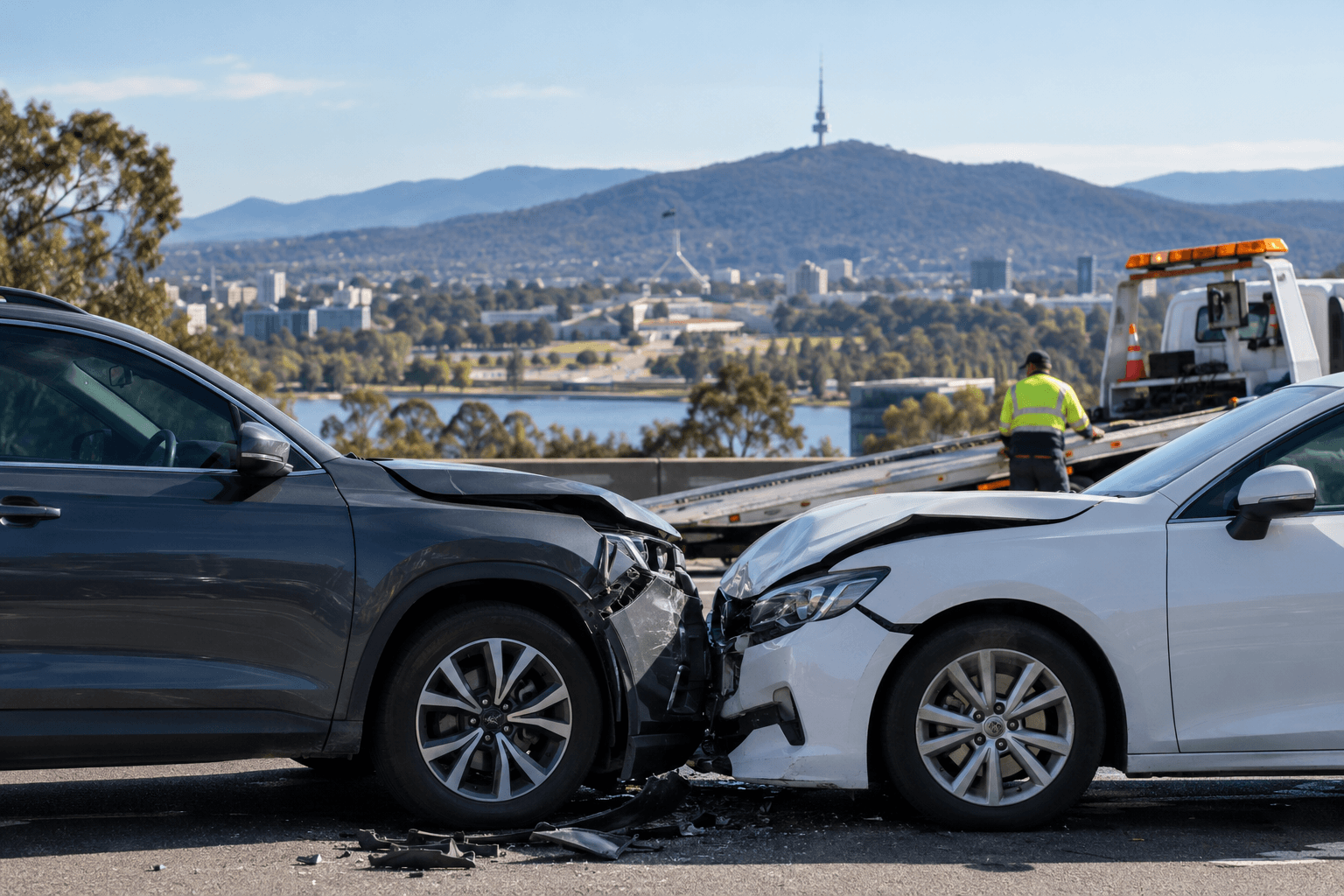
From Underground Towing & Salvage’s experience assisting motorists across Tasmania, many recovery call-outs involve vehicles that are no longer safe to drive despite occupants escaping without life-threatening injuries.
Serious vehicle damage, suspension failures, deployed airbags and structural impacts frequently require professional recovery even when a crash does not contribute to the annual road toll.
Has Tasmania Achieved Its Towards Zero Road Safety Goals?
Tasmania’s Towards Zero Road Safety Strategy 2017–2026 established an ambitious target of reducing annual deaths and serious injuries to fewer than 200 people by 2026.
The strategy adopted the internationally recognised Safe System approach, focusing on safer roads, safer vehicles, safer speeds and safer road users.
The latest results show that this target has not been achieved.
With 324 people killed or seriously injured during 2025, Tasmania remains well above its original objective despite improvements in some individual years.
Recognising this, the Tasmanian Government is now developing its next road safety strategy to address ongoing challenges, including population growth, changing travel patterns and persistent levels of serious road trauma.
Rather than indicating failure of individual initiatives, these results highlight the complexity of improving road safety across a state where motorists regularly travel between dense urban areas, winding rural roads and long-distance regional highways.
Where Do Tasmania's Most Serious Road Crashes Occur?
Statewide road toll figures only tell part of the story. Understanding where crashes occur is equally important for identifying risk and improving road safety.
The database includes geographic coordinates and extensive crash attributes, allowing incidents to be analysed across Hobart, Launceston, Devonport, Burnie, regional highways and local road networks.
The state’s open spatial crash dataset also enables crash severity and location to be mapped, helping road authorities identify patterns that may not be visible through statewide totals alone.
Individual road reviews further demonstrate how local crash history informs infrastructure decisions.
For example, a Tasmanian Government review of Illawarra Road identified 42 reported crashes between 2020 and 2024, comprising four serious injury crashes, seven minor injury crashes, seven first-aid crashes and 24 property-damage crashes.
This highlights an important point for motorists. Roads do not need to record multiple fatalities before they become a safety concern.
Frequent property-damage and injury crashes can still indicate recurring risks that warrant engineering improvements, speed reviews or increased enforcement.
Rural Roads Continue to Produce the Most Severe Crashes
Tasmania’s road network extends well beyond its cities. Large sections of the state consist of regional highways, winding mountain roads and rural routes where higher travel speeds and roadside hazards increase the severity of collisions.
The Tasmanian Government estimates that around one-third of all fatal and serious injury crashes occur on roads included within the Safer Rural Roads Program.
Head-on collisions and run-off-road crashes are identified as two of the most significant contributors to severe trauma on these roads.
National evidence supports this trend. BITRE’s Road Trauma Australia report shows that fatality rates in regional Australia remain several times higher than those recorded in major metropolitan areas, reflecting the increased risks associated with higher speed limits, longer emergency response distances and roadside hazards.
These conditions also influence what happens after a crash.
Vehicles involved in rural collisions are often located considerable distances from repairers, depots and emergency resources. In many cases, they cannot simply be driven away from the scene.
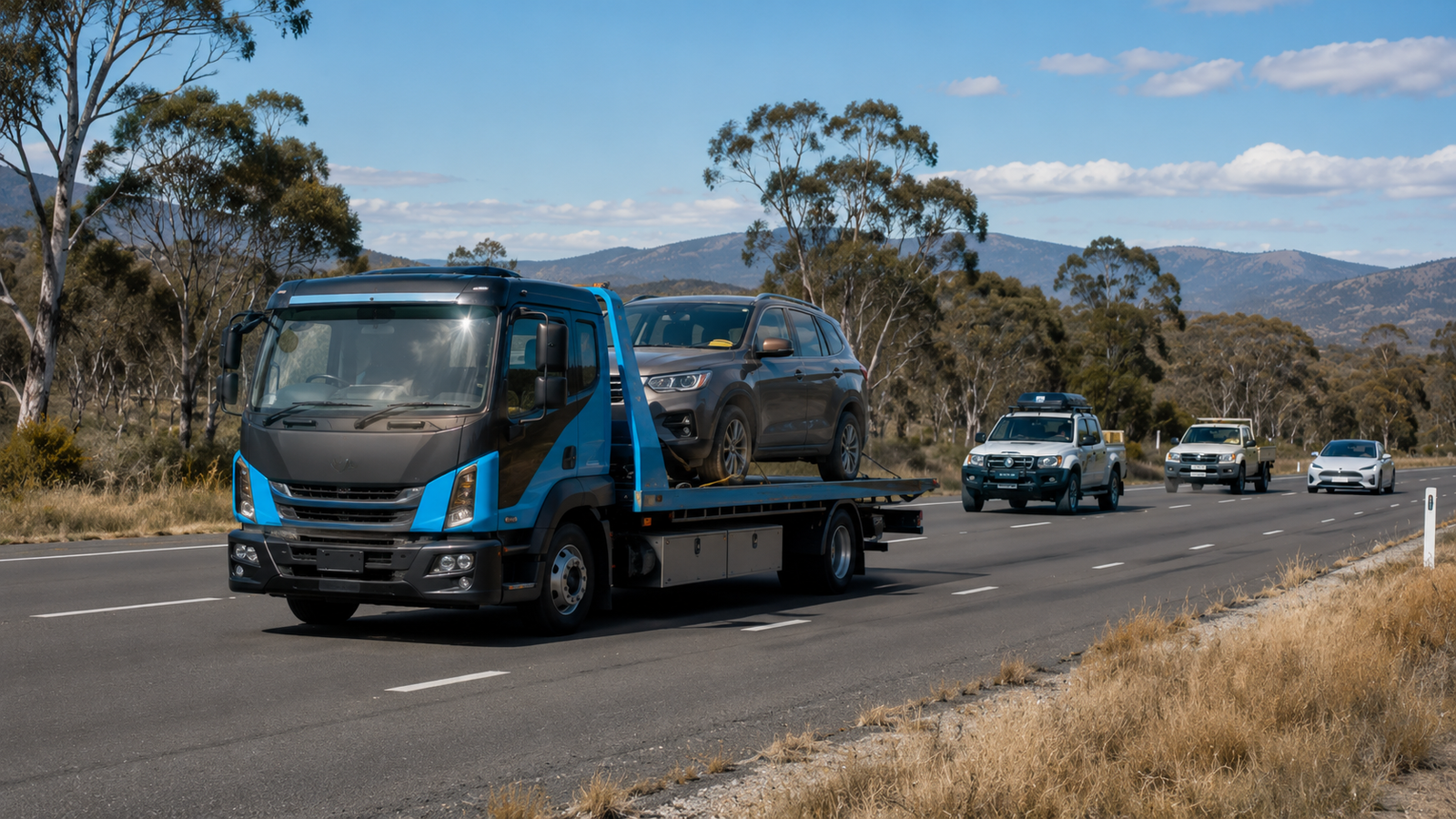
Professional recovery and transport become an essential part of restoring traffic flow and safely moving damaged vehicles.
If a vehicle requires transport following a breakdown or collision anywhere across the state, Underground Towing & Salvage’s Tasmania towing service provides professional vehicle transport throughout Tasmania.
Understanding Tasmania's Reported Crash Data
Fatal crashes attract the greatest attention, but they account for only a small proportion of all incidents recorded on Tasmania’s roads.
Tasmania’s official crash database captures a much broader range of events, including fatal crashes, serious injury crashes, minor injury crashes, first-aid crashes and eligible property-damage crashes reported to authorities.
This provides a far more complete picture of how frequently crashes occur across the state and where road safety issues are emerging.
Unlike the annual road toll, reported crash data reflects the day-to-day reality faced by motorists, insurers, emergency responders and recovery operators.
Many crashes never become headline news but still result in damaged vehicles, traffic disruptions and insurance claims.
The state’s open crash dataset also allows analysts to examine crash severity, location and trends over time, making it a valuable resource for identifying recurring problem areas rather than focusing solely on fatal incidents.
For towing operators, this distinction is important. Most accident recovery work follows crashes where occupants survive, but vehicles are no longer roadworthy.
A vehicle with extensive structural damage or deployed airbags often requires recovery regardless of whether the crash resulted in serious injury.
Which Road Users Are Most at Risk?
Road trauma does not affect every road user equally.
The annual Transport Services reports break fatalities and serious injuries down by road user type, allowing trends to be analysed across drivers, passengers, motorcyclists, pedestrians and cyclists. These breakdowns help identify which groups continue to experience the greatest risk on Tasmania’s roads.
Motorcyclists remain one of the most vulnerable road user groups.
Historical Tasmanian research found that motorcycles represented only 2.4% of registered vehicles while accounting for 23% of serious casualty crashes during the study period.
Although these figures relate to 2005–2009 rather than current conditions, they demonstrate why motorcycle safety continues to receive significant attention in Tasmania’s road safety programs.
Pedestrians and cyclists also require particular consideration.
Approximately 80% of Tasmania’s road network is managed by local government, making council roads critical for improving pedestrian crossings, cycling infrastructure, intersection treatments and other safety initiatives designed to protect vulnerable road users.
As newer annual reports become available, changes in road user trends can help determine whether education campaigns, infrastructure upgrades and enforcement activities are improving safety outcomes for these groups.
What Causes Serious Road Crashes in Tasmania?
No single factor explains every road crash.
Instead, serious collisions typically result from a combination of driver behaviour, road conditions, vehicle performance and environmental factors.
Tasmania Police and the Road Safety Advisory Council continue to focus on behaviours that consistently contribute to severe crashes.
Speeding
Speed remains one of the most significant contributors to crash severity because higher speeds reduce reaction time and increase impact forces.
During the 2024–25 Operation Safe Arrival campaign, Tasmania Police detected 777 speeding offences, demonstrating that excessive speed continues to be a widespread enforcement issue.
While speeding infringements should not be interpreted as crash statistics, they provide useful insight into driver behaviour across the state.
Drink and Drug Driving
Alcohol and drugs continue to be major enforcement priorities.
During the same operation, police conducted more than 12,670 roadside breath tests and detected 55 drink-driving offences.
Tasmania Police also publishes annual enforcement statistics covering traffic operations, roadside testing and broader road policing activities. These figures provide additional context when assessing long-term behavioural trends.
Driver Distraction
Distraction is often underestimated because it can be difficult to determine precisely what occurred immediately before a crash.
The Road Safety Advisory Council estimates that inattention and distraction contribute to nearly one-quarter of fatal and serious injury crashes across Tasmania.
Importantly, distraction extends well beyond mobile phone use. It can include interacting with passengers, adjusting in-vehicle controls, eating, fatigue-related lapses in concentration or simply failing to observe changing traffic conditions.
Fatigue
Fatigue presents another significant challenge, particularly across Tasmania’s regional road network where drivers may spend extended periods behind the wheel.
Research commissioned by the Road Safety Advisory Council found that 52% of surveyed Tasmanians reported driving while tired at least occasionally during the previous three months, while fatigue, distraction and inattention are estimated to contribute to 15–20% of serious and fatal crashes.
Unlike speeding or drink driving, fatigue often leaves little physical evidence after a collision, making prevention through driver education particularly important.
Heavy Vehicles, Commercial Transport and Fleet Exposure
Crash statistics become more meaningful when considered alongside the size of Tasmania’s vehicle fleet.
As at 31 December 2025, Tasmania recorded 735,165 registered vehicles and vehicle units, including 57,413 trucks and 22,761 motorcycles.
Commercial vehicles play a vital role in Tasmania’s economy, transporting freight between regional centres, ports and metropolitan areas every day.
Although heavy vehicles account for a relatively small proportion of registered vehicles, collisions involving trucks often result in more complex recovery operations due to vehicle size, cargo and road closures.
BITRE’s Road Vehicles Australia publication provides additional national context on vehicle fleet composition, while Road Trauma Australia analyses heavy vehicle involvement within Australia’s broader road safety trends.
Exposure also matters.
The Australian Bureau of Statistics’ Survey of Motor Vehicle Use demonstrates that the distance travelled by vehicles directly influences overall crash exposure.
Although the survey has now been discontinued, it remains a useful historical reference for understanding transport activity across Australia.
Motor Accident Insurance Claims Reveal the Wider Impact of Road Trauma
Road safety cannot be measured through crash statistics alone.
Insurance claims provide another valuable perspective by illustrating how many people require compensation following road crashes, regardless of whether those incidents contribute to annual fatality totals.
The Motor Accidents Insurance Board (MAIB) received 1,953 new claims during the 2023–24 financial year, representing a 2.8% increase compared with the previous year. The report also recorded a claim frequency of 3.2 claims per 1,000 registered vehicles.
These figures should not be interpreted as crash totals.
A single crash may generate multiple claims, while some crashes result in no claims at all. Likewise, claim data follows financial years rather than calendar years, making it a complementary measure rather than a direct comparison with annual road fatality statistics.
MAIB also contributes to improving road safety outcomes across Tasmania through funding and community investment.
During 2024–25, the organisation provided $580,000 to support Tasmania Fire Service and State Emergency Service road rescue programs, reinforcing the broader network of organisations responding to serious crashes across the state.
Hospital Data Shows the Broader Burden of Road Trauma
Police crash reports capture what occurs at the scene, but they do not fully represent the longer-term health impacts experienced by injured road users.
The Australian Institute of Health and Welfare monitors transport-related hospitalisations across Australia, providing additional insight into injury outcomes by age, gender, remoteness and transport mode.
Hospital data highlights that road trauma extends well beyond immediate emergency response.
Many people involved in crashes require surgery, rehabilitation or ongoing treatment long after the vehicles have been removed from the road.
This broader health perspective reinforces why reducing serious injuries remains just as important as lowering the annual road toll.
How Road Safety Statistics Influence Accident Recovery Across Tasmania
Behind every crash statistic is a real recovery operation.
Some incidents involve little more than arranging alternative transport after a minor collision.
Others require traffic management, specialist lifting equipment, long-distance vehicle transport and close coordination between police, emergency services, insurers and recovery operators.
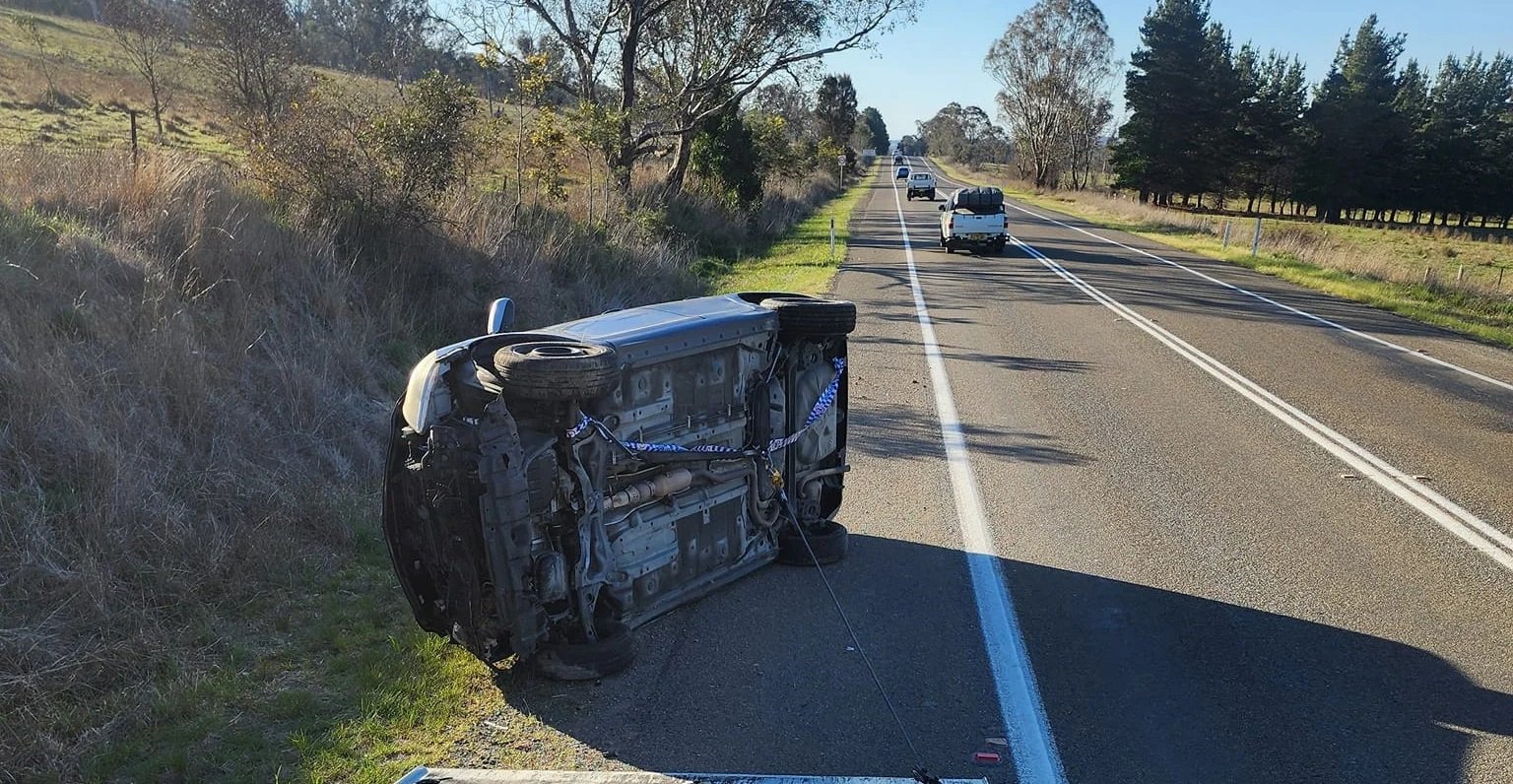
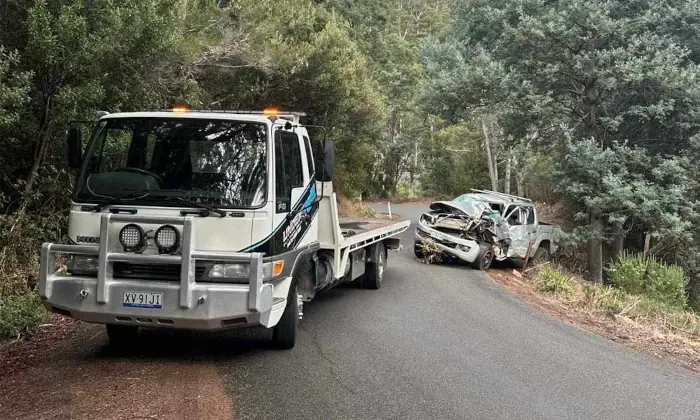
This is particularly true across regional Tasmania, where vehicles involved in head-on collisions, run-off-road crashes or rollovers often cannot be safely removed using standard towing methods.
The Transport Safety and Investigation Unit also plays an important role by investigating vehicles involved in certain serious and fatal crashes before they are released for recovery where required.
Once emergency services have completed their work, damaged vehicles frequently need secure transportation to repairers, storage facilities or insurers.
For motorists involved in a collision anywhere across the state, Underground Towing & Salvage provides professional Tasmania accident towing service, assisting with the safe recovery and transport of damaged vehicles after police and emergency responders have cleared the scene.
Need Accident Towing in Tasmania?
Even with ongoing improvements in road safety, serious crashes and vehicle breakdowns remain a reality across Tasmania. When they do happen, having an experienced recovery operator can make the process far less stressful.
Underground Towing & Salvage provides 24/7 accident towing and vehicle recovery across Tasmania. Our team safely recovers damaged vehicles from crash scenes and transports them to your preferred repairer, an insurer-approved repairer or another location you nominate.
If you need accident towing anywhere in Tasmania, visit our Accident Towing Tasmania page or contact our team for immediate assistance.